Algorithms Generalization Shortest Path Lowest Cost
Shortest Path Search
Basic concepts: starting state, successor function, goal
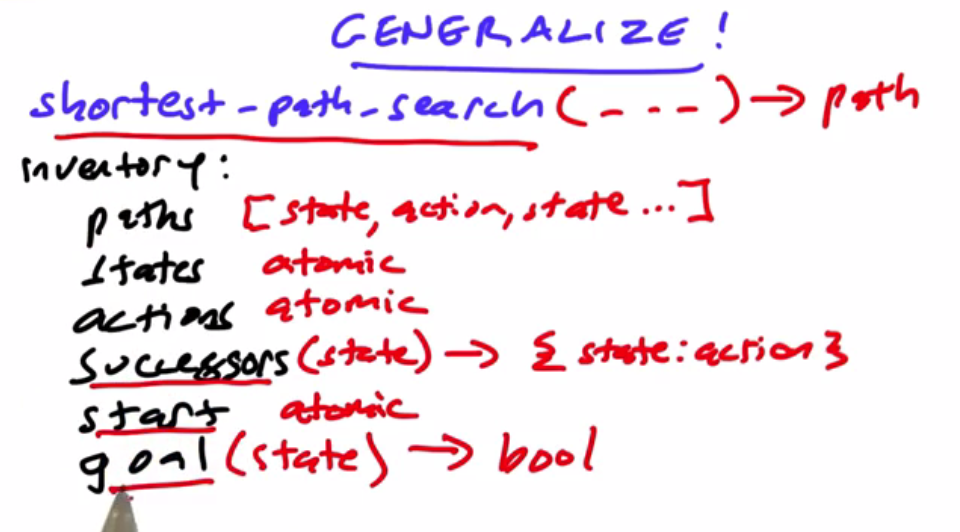
Using frontier's analysis:
####### Missionaries and Cannibals Game #######
# By Peter Norvig, Udacity.com CS212 Lesson 4
# -----------------
# User Instructions
#
# Write a function, mc_problem2, that solves the missionary and cannibal
# problem by making a call to shortest_path_search. Add any code below
# and change the arguments in the return statement's call to the
# shortest_path_search function.

def mc_problem2(start=(3, 3, 1, 0, 0, 0), goal=None):
    # your code here if necessary
    if goal is None:
        goal = (0, 0, 0) + start[:3]
    return shortest_path_search(start, csuccessors, all_gone) # <== insert arguments here

def all_gone(state): return state[:3] == (0, 0, 0)

def shortest_path_search(start, successors, is_goal):
    """Find the shortest path from start state to a state
    such that is_goal(state) is true."""
    if is_goal(start):
        return [start]
    explored = set()
    frontier = [ [start] ]
    while frontier:
        path = frontier.pop(0)
        s = path[-1]
        for (state, action) in successors(s).items():
            if state not in explored:
                explored.add(state)
                path2 = path + [action, state]
                if is_goal(state):
                    return path2
                else:
                    frontier.append(path2)
    return Fail
Fail = []

def csuccessors(state):
    """Find successors (including those that result in dining) to this
    state. But a state where the cannibals can dine has no successors."""
    M1, C1, B1, M2, C2, B2 = state
    ## Check for state with no successors
    if C1 > M1 > 0 or C2 > M2 > 0:
        return {}
    items = []
    if B1 > 0:
        items += [(sub(state, delta), a + '->')
                  for delta, a in deltas.items()]
    if B2 > 0:
        items += [(add(state, delta), '<-' + a)
                  for delta, a in deltas.items()]
    return dict(items)

def add(X, Y):
    "add two vectors, X and Y."
    return tuple(x+y for x,y in zip(X, Y))

def sub(X, Y):
    "subtract vector Y from X."
    return tuple(x-y for x,y in zip(X, Y))

deltas = {(2, 0, 1,    -2,  0, -1): 'MM',
          (0, 2, 1,     0, -2, -1): 'CC',
          (1, 1, 1,    -1, -1, -1): 'MC',
          (1, 0, 1,    -1,  0, -1): 'M',
          (0, 1, 1,     0, -1, -1): 'C'}

def test():
    assert mc_problem2(start=(1, 1, 1, 0, 0, 0)) == [
                             (1, 1, 1, 0, 0, 0), 'MC->',
                             (0, 0, 0, 1, 1, 1)]
    assert mc_problem2() == [(3, 3, 1, 0, 0, 0), 'CC->',
                             (3, 1, 0, 0, 2, 1), '<-C',
                             (3, 2, 1, 0, 1, 0), 'CC->',
                             (3, 0, 0, 0, 3, 1), '<-C',
                             (3, 1, 1, 0, 2, 0), 'MM->',
                             (1, 1, 0, 2, 2, 1), '<-MC',
                             (2, 2, 1, 1, 1, 0), 'MM->',
                             (0, 2, 0, 3, 1, 1), '<-C',
                             (0, 3, 1, 3, 0, 0), 'CC->',
                             (0, 1, 0, 3, 2, 1), '<-C',
                             (0, 2, 1, 3, 1, 0), 'CC->',
                             (0, 0, 0, 3, 3, 1)]
    return 'tests pass'

print test()
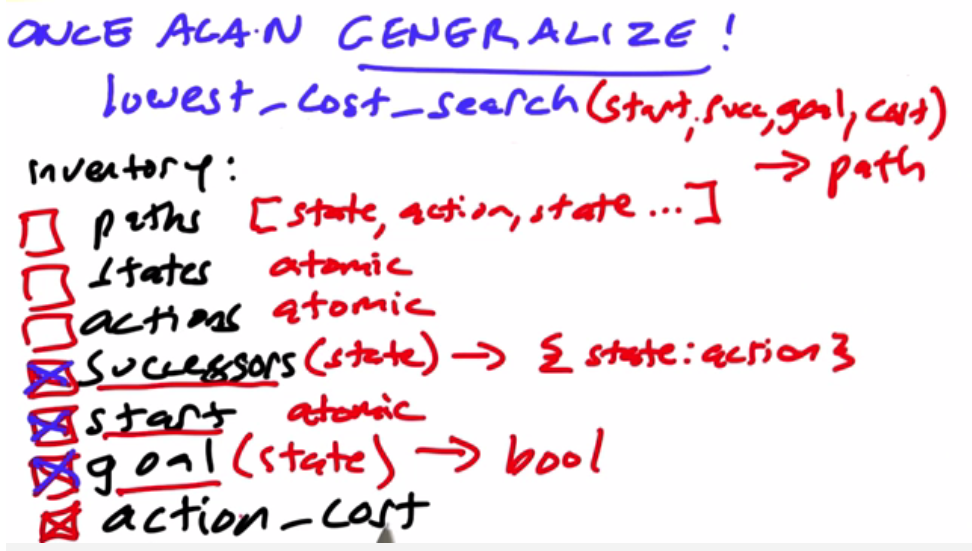
Lowest Cost Search
Each movement on the path can have different cost
####### The Bridge Game #######
# By Peter Norvig, Udacity.com CS212 Lesson 4
# -----------------
# User Instructions
#
# In this problem, you will generalize the bridge problem
# by writing a function bridge_problem3, that makes a call
# to lowest_cost_search.

def bridge_problem3(here):
    """Find the fastest (least elapsed time) path to
    the goal in the bridge problem."""
    start = (frozenset(here) | frozenset(['light']), frozenset())
    return lowest_cost_search(start, bsuccessor2, all_over, bcost)

def all_over(state):
    here, there = state
    return not here or here == set(['light'])

def lowest_cost_search(start, successors, is_goal, action_cost):
    """Return the lowest cost path, starting from start state,
    and considering successors(state) => {state:action,...},
    that ends in a state for which is_goal(state) is true,
    where the cost of a path is the sum of action costs,
    which are given by action_cost(action)."""
    Fail = []
    explored = set() # set of states we have visited
    frontier = [ [start] ] # ordered list of paths we have blazed
    while frontier:
        path = frontier.pop(0)
        state1 = final_state(path)
        if is_goal(state1):
            return path
        explored.add(state1)
        pcost = path_cost(path)
        for (state, action) in successors(state1).items():
            if state not in explored:
                total_cost = pcost + action_cost(action)
                path2 = path + [(action, total_cost), state]
                add_to_frontier(frontier, path2)
    return Fail

def final_state(path): return path[-1]

def path_cost(path):
    "The total cost of a path (which is stored in a tuple with the final action)."
    if len(path) < 3:
        return 0
    else:
        action, total_cost = path[-2]
        return total_cost

def add_to_frontier(frontier, path):
    "Add path to frontier, replacing costlier path if there is one."
    # (This could be done more efficiently.)
    # Find if there is an old path to the final state of this path.
    old = None
    for i,p in enumerate(frontier):
        if final_state(p) == final_state(path):
            old = i
            break
    if old is not None and path_cost(frontier[old]) < path_cost(path):
        return # Old path was better; do nothing
    elif old is not None:
        del frontier[old] # Old path was worse; delete it
    ## Now add the new path and re-sort
    frontier.append(path)
    frontier.sort(key=path_cost)

def bsuccessors2(state):
    """Return a dict of {state:action} pairs.  A state is a (here, there) tuple,
    where here and there are frozensets of people (indicated by their times) and/or
    the light."""
    here, there = state
    if 'light' in here:
        return dict(((here  - frozenset([a, b, 'light']),
                      there | frozenset([a, b, 'light'])),
                     (a, b, '->'))
                    for a in here if a is not 'light'
                    for b in here if b is not 'light')
    else:
        return dict(((here  | frozenset([a, b, 'light']),
                      there - frozenset([a, b, 'light'])),
                     (a, b, '<-'))
                    for a in there if a is not 'light'
                    for b in there if b is not 'light')

def bcost(action):
    "Returns the cost (a number) of an action in the bridge problem."
    # An action is an (a, b, arrow) tuple; a and b are times; arrow is a string
    a, b, arrow = action
    return max(a, b)

def test():
    here = [1, 2, 5, 10]
    assert bridge_problem3(here) == [
            (frozenset([1, 2, 'light', 10, 5]), frozenset([])),
            ((2, 1, '->'), 2),
            (frozenset([10, 5]), frozenset([1, 2, 'light'])),
            ((2, 2, '<-'), 4),
            (frozenset(['light', 10, 2, 5]), frozenset([1])),
            ((5, 10, '->'), 14),
            (frozenset([2]), frozenset([1, 10, 5, 'light'])),
            ((1, 1, '<-'), 15),
            (frozenset([1, 2, 'light']), frozenset([10, 5])),
            ((2, 1, '->'), 17),
            (frozenset([]), frozenset([1, 10, 2, 5, 'light']))]
    return 'test passes'

print test()